
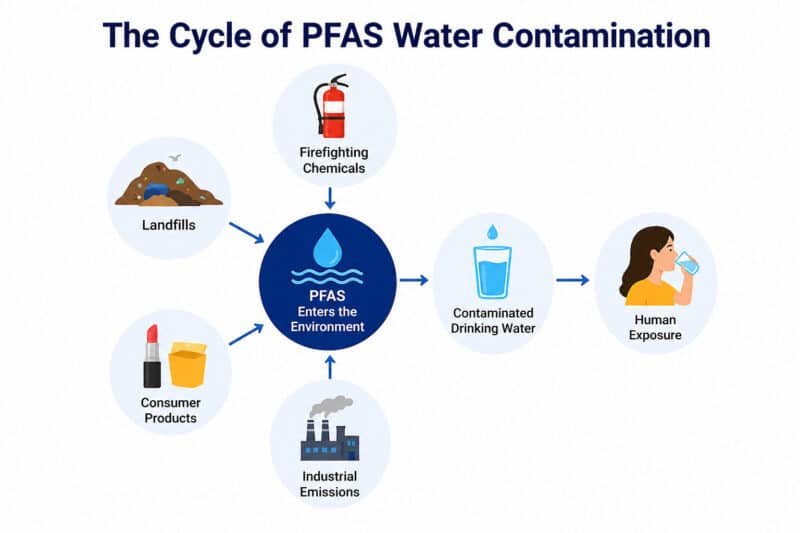
PFAS—often called “forever chemicals”—are a large family of synthetic compounds used for decades in products designed to resist water, grease, and stains. They have been used in firefighting foams, nonstick cookware, food packaging, textiles, and many industrial applications. The concern is simple: PFAS persist in the environment and can accumulate in the human body over time.
States like New Jersey have some of the strongest PFAS testing and drinking water standards in the country. That is excellent progress. But even strict municipal compliance does not necessarily mean zero PFAS at your kitchen tap. That is why many homeowners are turning to point-of-use (POU) filtration systems—filters installed where water is actually consumed.
How PFAS Can Still Reach Your Home
Even with municipal treatment and testing, there are several reasons PFAS reduction at the tap still makes sense:
1. Regulatory Limits Are Not Zero
Water systems may meet legal thresholds while still containing measurable PFAS levels.
2. Testing Is Periodic
Municipal systems test on schedules—not continuously every hour of every day.
3. Water Travels Through Infrastructure
After treatment, water passes through miles of pipes, storage tanks, valves, and local plumbing before reaching your faucet.
4. Daily Consumption Matters
Drinking water, cooking water, coffee, tea, and baby formula can all contribute to cumulative exposure.
5. Added Peace of Mind
A point-of-use filter gives homeowners direct control at the tap.
Why Point-of-Use Filtration Makes Sense
A high-quality under-sink system can help reduce PFAS directly where you drink and cook. Many systems may also reduce:
- Chlorine taste and odor
- VOCs
- Some metals
- Sediment
- Other contaminants depending on certification
Think of municipal treatment as the first barrier, and home filtration as the second barrier.
Best PFAS Filtration Systems Under $750
1. Best Overall Value: iSpring RCC7AK Reverse Osmosis
Excellent performance, strong reputation, and broad contaminant reduction. Reverse osmosis is one of the most effective technologies for PFAS reduction. Great balance of cost and performance.
iSpring RCC7AK 6-Stage Reverse Osmosis System
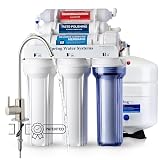
- PATENTED DESIGN – The top-mounted fastener allows for easy countertop installation entirely from above, eliminating the hassle of tightening the nut from underneath the sink.
- MINERAL BOOST – The patent-pending natural mineral AK stage delivers spring water with a balanced, healthy pH and multiple essential minerals.
- SEE WHAT’S CAUGHT – The transparent first-stage filter housing makes it easy to monitor contaminant buildup, ensuring timely filter changes.

Best use: Families wanting strong protection at a reasonable price.
2. Best Modern Option: Waterdrop G3P600 Reverse Osmosis System
Tankless design saves cabinet space and offers superior, deeper filtration performance, utilizing an 8-stage, 0.0001μm Reverse Osmosis membrane system over other systems.

- [Trusted certifications]: Waterdrop G3P600 reverse osmosis system is certified against NSF/ANSI 58 for TDS reduction and NSF/ANSI 372 certified for lead-free material. Also it has been tested and…
- [8-stage filtration]: Tested by official third-party laboratory (SGS), the reverse osmosis system can effectively reduce TDS, chromium, PFAS, radium, fluoride, arsenic salt, iron, calcium, particles…
- [Smart display faucet]: The tankless reverse osmosis system is built with a smart display faucet. For instance, the TDS monitor tells you the quality of your filtered water, while the filter life…
Best use: High-capacity, under-sink drinking water filtration system for households (2–5 people) that prioritize convenience, space-saving design, and high-quality, on-demand purified water
3. Best Non-RO Simplicity: Aquasana 3-Stage Max Flow
If you prefer no wastewater and easier maintenance, this high-quality carbon-based system is a practical option.

- Exceptional Water Filtration Performance: WQA certified to NSF 42, 53 & 401 to reduce up to 99.99% of 78 contaminants including lead, PFAS, chloramines, pharmaceuticals, & microplastics while…
- Fast, Max-Flow Output: Delivers filtered water at a rate of 0.72 gallons per minute — 7X faster than the leading pitcher filter. Perfect for cooking, filling water bottles, and everyday hydration…
- Cost-Effective & Long-Lasting: At less than 10 cents per gallon, this filter provides a cost-effective way to enjoy cleaner water. Lasts up to 6 months or 800 gallons before replacement is needed…
Best for: Simplicity, ease of installation, and solid everyday filtration.
Which System Should You Choose?
Choose Reverse Osmosis If:
- PFAS reduction is top priority
- You want broad contaminant removal
- You drink lots of tap water daily
Choose Carbon Under-Sink If:
- You want simpler maintenance
- No wastewater discharge
- Better taste/odor + practical filtration
My Sustainable Sherri Perspective
Clean water is one of the highest-return investments you can make for your health. Even with strong New Jersey regulations, point-of-use filtration puts control in your hands—where it matters most.
Municipal systems do important work. But filtering water at the tap is often the smartest final step.
Shop my online store for other Point-Of-Use water filtration systems
Leave a Reply