
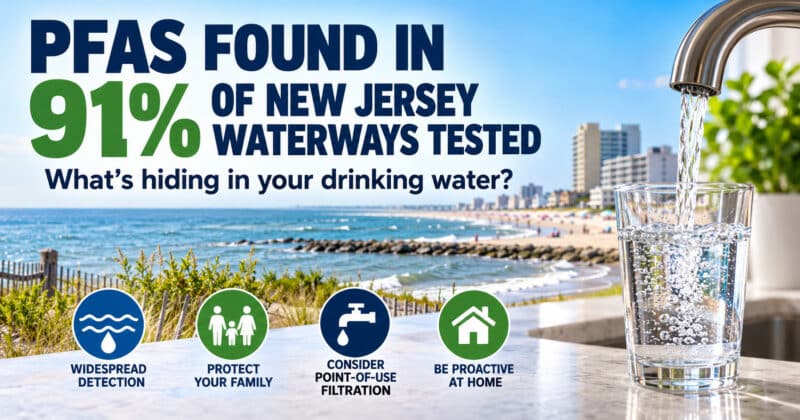
of New Jersey’s 21 counties.
Beautiful beaches don’t guarantee contaminant-free water. Here’s why New Jersey homeowners should take an active role in protecting their family’s drinking water.
Living along the Jersey Shore, we’re fortunate to enjoy beautiful beaches, scenic back bays, and an extraordinary coastal environment. But what we can’t see in our water may be just as important as what we can.
A new report released in October 2026 raises serious concerns about the widespread presence of PFAS, commonly known as forever chemicals, in New Jersey’s waterways and all across America.
According to an October 14 article published by NJ Spotlight News, PFAS were detected in 78 of 86 New Jersey surface-water locations sampled—an alarming 91%!
What Did the Study Find?
The findings are a reminder that protecting our water resources—and our families—requires ongoing attention.
The report, PFAS in America’s Rivers and Lakes, analyzed U.S. Environmental Protection Agency surface-water sampling data collected between 2022 and 2024.
Among its findings:
- 91% of New Jersey sampling locations contained detectable PFAS.
- PFAS were found in approximately 83% of 1,602 locations nationwide.
- PFAS were detected in 98% of samples from the lower Delaware River, south of Trenton.
The findings underscore how widespread these persistent chemicals have become.
Importantly, the study examined surface water, not household tap water. It does not mean that 91% of New Jersey homes have PFAS-contaminated drinking water. However, rivers, lakes, and other waterways are important drinking-water sources, making these findings relevant to public health.
Read the NJ Spotlight News article
Why Should We Be Concerned About PFAS?
PFAS are a large family of manufactured chemicals used in products such as stain-resistant fabrics, water-repellent clothing, food packaging, and certain industrial applications.
Their chemical structure makes many PFAS extremely persistent in the environment, earning them the nickname forever chemicals.
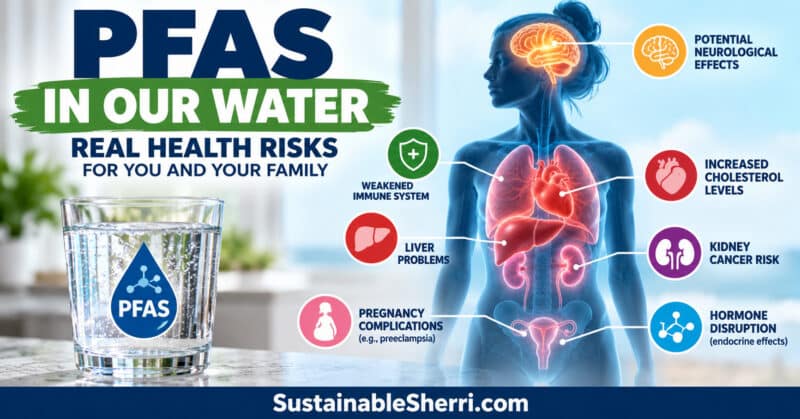
Research has linked exposure to certain PFAS with health concerns, including:
- Increased cholesterol levels
- Reduced immune response to some vaccines
- Liver effects
- Pregnancy-related complications
- Increased risk of certain cancers
The health risks depend on the specific PFAS, exposure level, and duration. Not every PFAS has been studied equally.
Because these chemicals can persist in the environment and accumulate in the body, reducing unnecessary exposure is a sensible precaution.
Isn’t My Municipal Water Already Tested and Treated?
Yes! New Jersey has established drinking-water standards for several PFAS, and public water utilities are responsible for monitoring and meeting applicable requirements.
But here’s something important to understand:
Municipal water treatment is essential, but no water utility can guarantee the absence of every possible contaminant at every household faucet.
There are thousands of PFAS chemicals, along with other potential contaminants, including lead, pesticides, industrial chemicals, and disinfection byproducts.
Water utilities test for regulated contaminants and follow established treatment requirements. However, not every emerging contaminant is routinely monitored, and water quality can also be affected by plumbing materials and conditions between the treatment plant and your faucet.
That doesn’t mean your municipal water is unsafe. It means that staying informed and taking reasonable precautions can provide an additional layer of protection.
Living in Ventnor, Margate, Longport, Brigantine, or Atlantic City? Don’t Assume Your Water Is Contaminant-Free.
Our Jersey Shore communities are surrounded by beautiful beaches, bays, and waterways. But beautiful scenery tells us very little about the chemical composition of the water coming from our kitchen faucets.
Whether you live in Ventnor, Margate, Longport, Brigantine, Atlantic City, or elsewhere in New Jersey, it’s worth asking:
Do I know what’s in my drinking water?
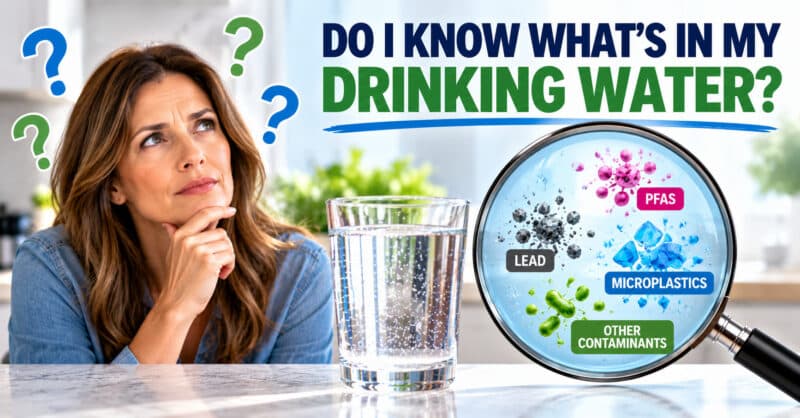
The answer begins with reviewing your water utility’s annual Consumer Confidence Report, understanding where your water originates, and identifying which contaminants are monitored.
Residents with private wells should arrange appropriate testing because private wells are not regulated in the same way as public drinking-water systems.
And for families seeking additional protection, point-of-use water filtration may be a practical solution.
Why I Recommend Considering Point-of-Use Water Filtration
A point-of-use (POU) filtration system treats water where you use it—typically at your kitchen sink.
Rather than filtering every gallon used throughout your home, you can focus on the water your family drinks and uses for cooking.
Depending on the system, effective filtration technologies may include:
Activated Carbon Filtration
Certain activated carbon filters can reduce PFOA, PFOS, and other contaminants. Performance depends on the filter’s design, certification, and maintenance.
Reverse Osmosis (RO)
Reverse osmosis systems use a specialized membrane to reduce a broad range of dissolved contaminants, including certain PFAS. However, RO systems also generate wastewater and may require more extensive maintenance.
Ion Exchange Filtration
Specialized ion-exchange media can capture certain PFAS, although effectiveness varies by system and water chemistry.
Not All Water Filters Remove PFAS!
This is extremely important.
A filter that improves taste or removes chlorine is not necessarily effective against PFAS.
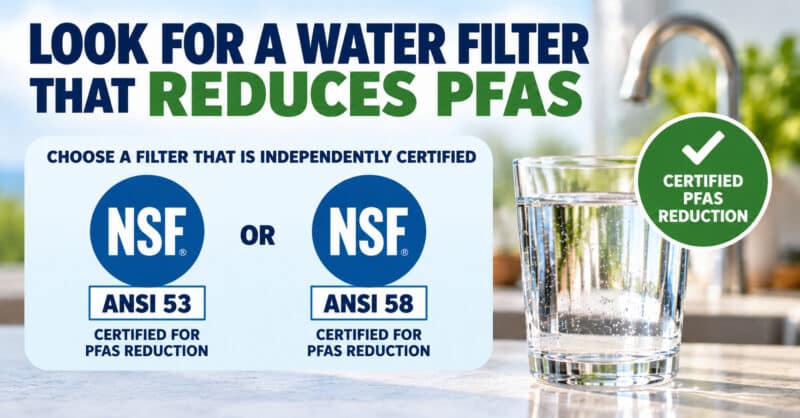
Look for independent NSF/ANSI 53 or NSF/ANSI 58 certification that specifically includes PFAS reduction, and check the manufacturer’s performance data for the exact contaminants covered.
Remember that no single filter should be assumed to remove every PFAS chemical.
Regular cartridge replacement is also essential. Even a high-performing filtration system becomes less effective if it isn’t properly maintained.
What About Lead and Other Hidden Contaminants?
PFAS aren’t the only contaminants homeowners should consider.
Older plumbing materials and service lines can introduce lead into drinking water, even when water leaving the municipal treatment plant meets regulatory requirements.
New Jersey is working to replace lead service lines, but homeowners should understand their property’s plumbing and potential exposure risks.
Read my previous article:
Getting the Lead Out: What New Jersey’s Water Line Mandate Means for Your Home
And remember, water exposure isn’t limited to drinking. Showers can involve exposure to chlorine-related compounds and other substances, although shower filters serve different purposes and should not be assumed to remove PFAS.
Learn more:
Five Simple Steps to Protect Your Family’s Drinking Water
You don’t need to spend thousands of dollars or become a water-treatment expert to make informed decisions.
- Know your water source. Find out which utility supplies your drinking water and review its annual water-quality report.
- Understand your home’s plumbing. Check for lead service lines and older plumbing materials that may affect water quality.
- Consider water testing. Use a qualified laboratory when you have concerns about contaminants not covered by routine municipal testing.
- Choose a certified point-of-use filter. Select a system independently tested for the specific contaminants you want to reduce.
- Maintain your filtration system. Replace cartridges according to the manufacturer’s instructions.
These steps can help reduce uncertainty and unnecessary exposure while supporting the work already being done by our public water utilities.
Sustainable Sherri’s Message: Be Proactive, Not Fearful
As a chemical engineer and environmental advocate, I believe strongly in using science, education, and practical solutions to help people make informed decisions.
Our municipal water utilities perform an essential public service, and strong water-quality standards and pollution prevention remain critical.
But protecting our families doesn’t have to stop at the water treatment plant.
We can take an active role by learning what’s in our water, understanding the limitations of different treatment technologies, and making thoughtful choices about additional filtration.
The recent PFAS findings remind us that contaminants are often invisible—and that clean-looking water isn’t necessarily contaminant-free.
My message is simple: You can’t always see what’s in your water, but you can take steps to understand it and reduce your family’s exposure.
Protecting our health and our environment starts with awareness—and continues with action.
Cleaner Water. Healthier Homes. A More Sustainable Future.
— Sustainable Sherri
Continue Learning
PFAS in Drinking Water: Why Point-of-Use Filtration Still Matters in New Jersey
Explore practical ways to reduce PFAS exposure through certified drinking-water filtration.
Understand what shower filters can—and cannot—do.
Getting the Lead Out: What New Jersey’s Water Line Mandate Means for Your Home
Learn why lead service-line replacement matters for New Jersey homeowners.
Source: Benjamin J. Hulac, NJ Spotlight News, October 14, 2026, reporting on PFAS in America’s Rivers and Lakes, based on EPA surface-water sampling data from 2022–2024.
Featured Water Purification Products
These remove PFAS from drinking water.

- Exceptional Water Filtration Performance: WQA certified to NSF 42, 53 & 401 to reduce up to 99.99% of 78 contaminants including lead, PFAS, chloramines, pharmaceuticals, & microplastics while…
- Fast, Max-Flow Output: Delivers filtered water at a rate of 0.72 gallons per minute — 7X faster than the leading pitcher filter. Perfect for cooking, filling water bottles, and everyday hydration…
- Cost-Effective & Long-Lasting: At less than 10 cents per gallon, this filter provides a cost-effective way to enjoy cleaner water. Lasts up to 6 months or 800 gallons before replacement is needed…


- THREE-STAGE FILTRATION: Brondell’s Coral Three-Stage filter set consists of a sediment filter, pre-carbon filter, and carbon block filter. Get rid of contaminants in your water while leaving behind…
- HIGH CAPACITY FILTERS: Enjoy filtered water all year round with these high capacity water filters. With a double O-ring filter seal to prevent leaks, these filters are designed to last 12 months with…
- BRAND YOU CAN TRUST: This Brondell filter system is Gold Seal-certified by the Water Quality Association for trusted performance and is certified for NSF/ANSI standards 42, 53, and 372 and CSA B…
Leave a Reply